
An easy guide to a complicated but important area for both practitioners and patients to understand
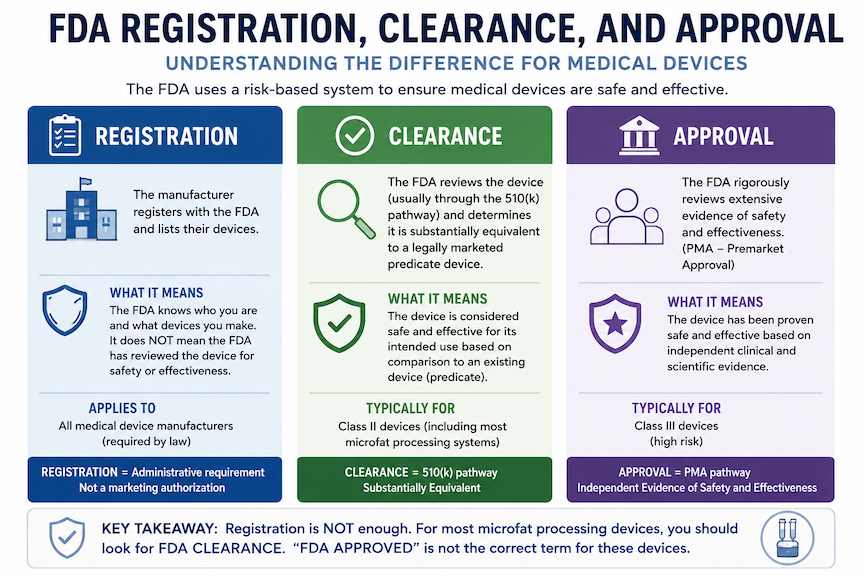
“FDA Registered/Listed,” “FDA Cleared,” and “FDA Approved” are three very different terms that can easily be misunderstood. This can confuse not only practitioners and patients, but even people working within the medical device industry.
The FDA’s role in the medical device market is to protect the public. This is done by ensuring that devices sold are both safe and effective. At the same time, the FDA does not want to burden manufacturers with steps and costs that can limit competition and the availability of new and innovative devices and treatments. These are the reasons for the three different labels. Further, the labels are connected to the risk level of a given device.
Medical devices are determined by the FDA to fall into one of three classes:
Class I – the lowest risk (FDA Registration)
“Class I” devices are of the lowest risk to the patient, where product failure is unlikely to cause serious harm. Examples of these devices might be examination gloves, bandages, tongue depressors, etc. These devices generally require that the manufacturer be registered with the FDA and that the device is listed. Often the device and manufacturer must comply with various quality requirements.
Class II – Moderate risk
Most medical devices, including all current microfat processing systems, are classified as “Class II” devices. Class II devices are more complex and have more risk than Class I devices. The failure of a Class II device could cause injury but generally not life-threatening harm.
Most medical devices, from diagnostic ultrasound to infusion pumps to surgical lasers and arthroscopes, are Class II devices.
Class II devices generally require FDA Clearance, which means that the manufacturer of the device has shown that the device is substantially equivalent, from a safety and effectiveness standpoint, to another device that is legally marketed. The other device is called the “predicate device” and the process by which the manufacturer proves the equivalency to the predicate device is called a 510(k) pathway or clearance. The manufacturer not only has to show equivalence, it must also meet certain controls which may include sterility validation, bench testing, performance standards, and other controls.
Efficiency and Competition – the Reasons for Class II
If every FDA Cleared device has to have a predicate, then how did the first device get cleared? In some situations, FDA Clearance can be granted without a predicate device. This is often through a path/classification called De Novo where the manufacturer provides evidence that allows the FDA to determine that the device presents low or moderate risk and that there is reasonable assurance of safety and effectiveness. From that point, the device becomes the predicate for other devices. The evidence required for a De Novo submission is generally less extensive than that required for Class III devices using a Premarket Approval (PMA) application (described below) because the De Novo device has been determined to present lower risk.
By allowing manufacturers to reference predicate devices, the FDA maintains safety and effectiveness standards but encourages manufacturers to offer new products more quickly and inexpensively, allowing innovation and competition to flourish.
Class III – High Risk
“Class III” devices support or sustain life, may be implanted long term, and present a significant risk if they fail.
Examples of Class III devices include artificial heart valves, pacemakers and defibrillators, neurostimulators, heart stents, and others.
Class III devices require FDA Approval. FDA Approval means that the manufacturer of the device must provide extensive evidence of safety and effectiveness that often include human clinical trials, laboratory and engineering testing, animal studies, statistical analyses, and long term follow-up. This is a lengthy and expensive process and the manufacturer of every Class III device must independently demonstrate the safety and effectiveness of the device through valid scientific evidence. There are no predicates to refer to.
The process to achieve FDA Approval is called PMA or Premarket Approval.
Microfat Devices
You may possibly see microfat devices that are labelled “FDA Registered” or “FDA Listed.” A microfat processing device marketed only as “FDA Registered” or “FDA Listed” should prompt additional questions. A Class II microfat processing system for sale in the US should have an FDA clearance for that intended use. Devices that are merely FDA Registered may be registered for some other use beside microfat processing, but the device is not legally authorized to be used for microfat processing. Registration or listing alone does not mean the FDA has reviewed the device for safety and effectiveness for microfat processing.
Likewise, a Class II microfat processing system advertised as “FDA Approved,” should be carefully examined. The FDA generally uses the term “approved” for devices that have undergone the Premarket Approval (PMA) process for Class III devices. Microfat processing systems are generally Class II devices cleared through the 510(k) process, so the appropriate terminology is “FDA Cleared.”
Bottom line
Any microfat system you select needs to be FDA Cleared to be legally sold and you should verify that it is marked as such. “FDA Registered” or “FDA Listed” is insufficient, while “FDA Approved” may be untrue.
Rest assured the MiniTC® system from Jointechlabs is a Class II medical device that has been FDA Cleared.
 English
  Deutsch
  Italiano
  Français